
- May 12, 2026
- 11 min read
Artificial Intelligence is no longer just a future idea. It is already changing how people work, learn, communicate, and create. AI can write articles, detect diseases, create music, drive cars, and even help scientists discover new medicines. Every year, machines become smarter and faster.
This creates one big question:
If AI can solve the world’s hardest problems, what will humans do?
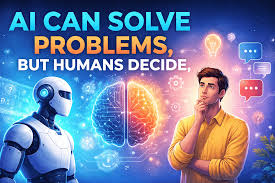
Many people fear that humans may become useless in the future. But the truth is more interesting. AI may replace many tasks, but it cannot replace what makes humans truly human.
The future is not about humans fighting against AI. It is about humans discovering a new purpose.
AI Can Solve Problems, But Not Everything
AI is powerful because it can process huge amounts of data in seconds. It can find patterns that humans may never notice. In fields like science, medicine, engineering, and business, AI will likely become better than humans at many technical jobs.
For example:
- AI can help doctors detect cancer earlier.
- AI can predict climate changes faster.
- AI can automate factory work.
- AI can write computer code.
- AI can manage financial systems.
In the future, AI may solve problems that humans struggled with for centuries.
But solving problems is not the same as understanding life.
A machine can calculate emotions, but it cannot truly feel love, pain, hope, or fear. AI can create a song, but it does not experience heartbreak. It can write poetry, but it does not dream.
That difference is extremely important.
Humans Are More Than Intelligence
For a long time, society believed intelligence was the most valuable human quality. People who could memorize faster, calculate better, or analyze deeply were considered superior.
But AI changes this idea completely.
When machines become smarter than humans in many areas, human value will no longer depend only on intelligence. Instead, qualities like creativity, empathy, ethics, imagination, and emotional connection will become even more important.
Humans are not just thinking machines.
Humans are conscious beings.
We laugh, cry, love, imagine, suffer, and search for meaning. These experiences cannot simply be copied into an algorithm.
AI may know everything written about happiness, but it cannot actually feel happiness.
The Biggest Human Crisis May Be Purpose
The real danger of AI is not only job loss. The bigger danger is losing purpose.
For thousands of years, people worked to survive. Farmers grew food. Builders created homes. Teachers shared knowledge. Hard work gave life structure and meaning.
But what happens if machines do most of the work?
Imagine a future where AI handles transportation, medicine, law, engineering, and business automatically. Humans may suddenly have more free time than ever before.
At first, this sounds amazing.
But many people connect their identity to their work. Without struggle or responsibility, some may feel empty. Humans need purpose, goals, and emotional connection to feel fulfilled.
This is why the future of AI is also a psychological challenge.
Technology can make life easier, but it cannot automatically make life meaningful.
Human Creativity Will Become More Valuable
As AI-generated content becomes common, real human creativity may become more valuable than ever.
Think about music.
If AI can instantly create perfect songs, people may start caring less about perfection and more about authenticity. They may want music created from real human emotions and experiences.
The same thing may happen in:
- Writing
- Art
- Movies
- Leadership
- Relationships
- Education
People may value human stories because they come from real life experiences.
A human painting may matter more because it carries emotion, struggle, and individuality.
In a world full of artificial intelligence, authentic humanity may become rare and powerful.
AI Will Expand Human Potential
Many people think AI will replace humans completely. But history shows that technology usually changes human work instead of destroying humanity itself.
When calculators were invented, mathematics did not disappear. When the internet arrived, human communication exploded instead of ending.
AI will likely become a tool that expands human abilities.
A small team with AI may build things that once required huge companies. Scientists may discover cures faster. Students may learn better. Artists may create entirely new forms of expression.
AI can become a partner instead of an enemy.
The smartest future is not humans versus AI.
It is humans working with AI.
AI vs Humans: The Real Difference
The debate about AI vs humans often focuses on intelligence. But intelligence is only one part of being human.
Here is the real difference:
| AI | Humans |
|---|---|
| Processes data | Feels emotions |
| Learns patterns | Creates meaning |
| Works logically | Thinks emotionally and spiritually |
| Never tires | Experiences life |
| Optimizes tasks | Builds relationships |
AI may become more intelligent in technical areas, but humanity is much more than technical ability.
The Things AI Cannot Replace
Even if AI becomes incredibly advanced, some things will always remain deeply human.
1. Consciousness
Humans experience life directly. Machines process information, but they do not experience existence.
2. Morality
AI can follow rules, but humans decide what is right or wrong.
3. Empathy
Real emotional understanding comes from shared human experience.
4. Meaning
AI can optimize goals, but humans decide which goals are worth pursuing.
5. Spirituality and Philosophy
Questions like “Why are we here?” or “What makes life meaningful?” cannot be solved with data alone.
These are not technical problems.
They are human questions.
The Future May Be More Human Than Ever
Ironically, the rise of AI may push humans to reconnect with qualities they ignored for years.
Modern society often rewards productivity more than wisdom. But when machines handle productivity better than humans, society may begin valuing:
- Relationships
- Creativity
- Emotional intelligence
- Wisdom
- Ethics
- Community
- Inner peace
People may stop defining themselves only through jobs and money.
Instead, humanity may focus more on experience, exploration, and understanding life itself.
In a strange way, AI may force humans to become more human.
Conclusion
If AI solves the world’s hardest problems, humans will not disappear. Our role will simply evolve.
Machines may handle calculations, automation, and optimization. But humans will still bring meaning, emotion, imagination, and purpose into the world.
The future is not about competing with machines in speed or memory.
Machines can process information.
Humans can experience life.
And that may become the most valuable thing of all.
FAQ
1. Will AI replace humans completely?
No. AI may replace certain jobs and tasks, but human qualities like empathy, creativity, morality, and consciousness cannot easily be replaced.
2. What jobs are safest in the AI future?
Jobs involving emotional intelligence, leadership, creativity, strategy, and human interaction are likely to remain valuable.
3. Can AI become smarter than humans?
In many technical areas, AI is already outperforming humans. However, intelligence alone does not equal human consciousness or emotional understanding.
4. Is AI dangerous for humanity?
AI can be dangerous if used irresponsibly. The real challenge is ensuring humans use AI ethically and wisely.
5. What will humans do if AI does most work?
Humans may focus more on creativity, innovation, relationships, personal growth, and solving philosophical or social challenges.
6. Why are humans still important in an AI world?
Because humans provide meaning, values, emotions, ethics, and real-life experiences that machines cannot truly understand.
Tags: best web development company, digital marketing agency, ppc services Iin USA, seo services in USA, Webflow development services, website design company, Woocommerce website development, WordPress development services