
- April 28, 2026
- 11 min read
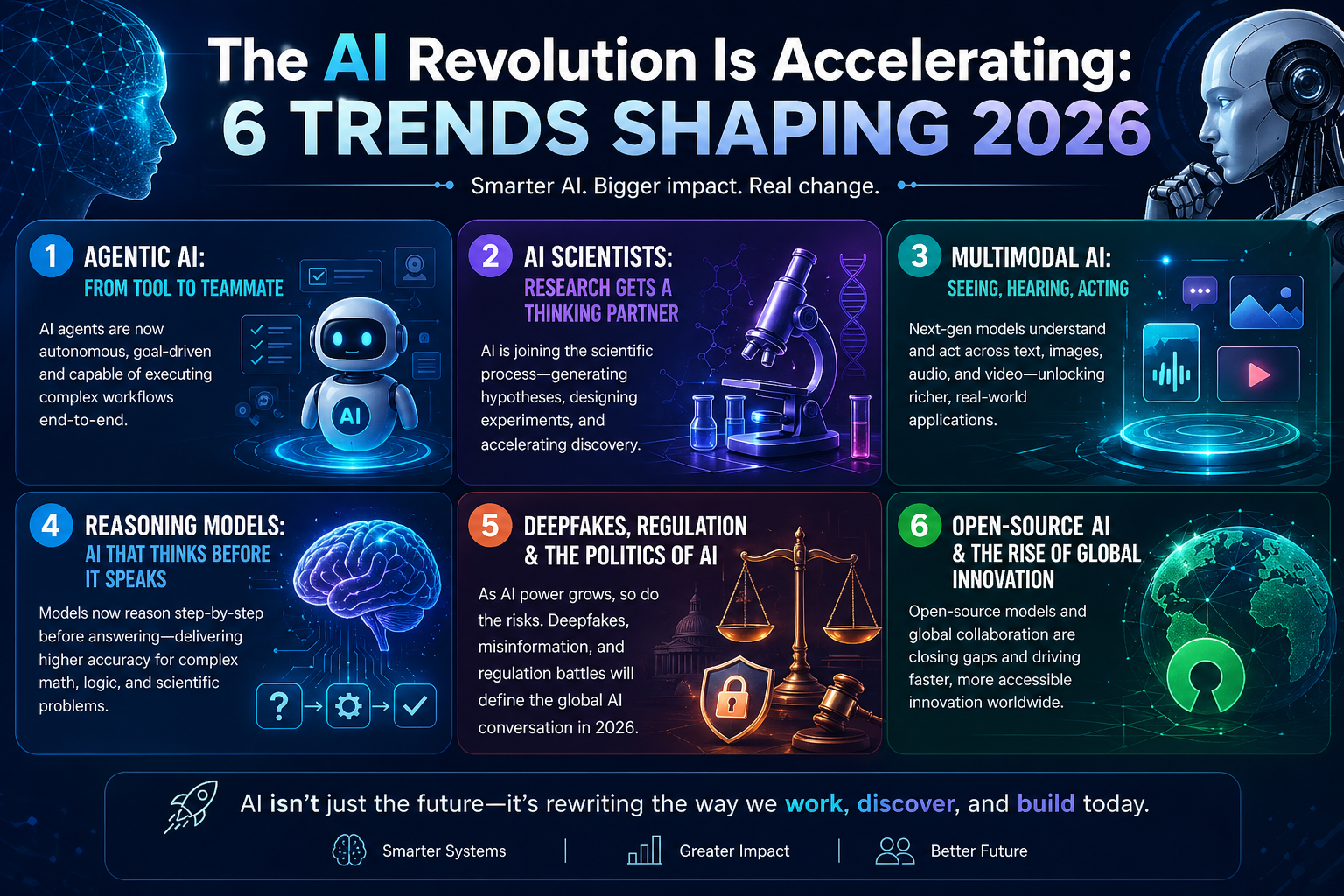
Artificial intelligence is no longer a buzzword or a future promise — it’s the fabric of how we work, discover, and build right now. But even within a landscape that moves at breakneck speed, certain ideas are rising above the noise in 2026. From AI teammates in the lab to the politics of who gets to govern this technology, here are the trends that matter most this year.
1. Agentic AI: From Tool to Teammate
The single biggest shift of 2026 is the rise of agentic AI — systems that don’t just answer questions, but set their own sub-goals, make decisions, and execute multi-step tasks with minimal hand-holding.
Gartner predicts that 40% of enterprise applications will leverage task-specific AI agents by 2026, up from less than 5% just a year ago. Google Cloud describes this as “the agent leap” — a move away from one-off prompts toward what it calls digital assembly lines that can run entire workflows end-to-end.
But the hype hasn’t come without hard lessons. Researchers at Anthropic and Carnegie Mellon have found that current agents make too many mistakes for high-stakes business processes, and cybersecurity vulnerabilities like prompt injection remain a real concern. The consensus among experts: agents are transformative in potential, but reliability and trust-building will define whether that potential is actually realized in 2026.
2. AI Scientists: Research Gets a Thinking Partner
One of the most quietly profound developments is AI moving into the scientific process itself — not just as a literature summarizer, but as a genuine hypothesis generator and experimental collaborator.
OpenAI, following Google DeepMind, has now built a dedicated team for AI in science. Microsoft Research’s Peter Lee puts it plainly: in 2026, AI won’t just write reports — it will actively join the process of discovery in physics, chemistry, and biology. The number of publications on AI for drug discovery has more than doubled over the past two years, according to Stanford’s 2026 AI Index.
Some researchers believe that AI co-scientists could one day reach Nobel Prize-worthy contributions. We’re not there yet — but the direction is unmistakable.
3. Multimodal AI: Seeing, Hearing, Acting
Language was just the beginning. The next generation of AI models can perceive and act across vision, audio, and text simultaneously — more like a human colleague than a text-processing engine.
IBM’s experts describe “multimodal digital workers” that can autonomously interpret complex cases — healthcare imaging, legal documents, manufacturing defects — and act on them. Smaller, more specialized multimodal models are also gaining ground, with open-source projects like IBM’s Granite, AI2’s OLMo 3, and DeepSeek making capable, domain-tunable models available to enterprises that can’t afford to run frontier-scale systems.
Video generation has also crossed into practical territory. OpenAI’s Sora 2 and Google’s Veo 3.1 have moved video AI from demos to real production tools, with capabilities for richer audio and controlled editing.
4. Reasoning Models: AI That Thinks Before It Speaks
Early language models jumped straight to an answer. The new paradigm, pioneered by OpenAI’s o1 and now adopted by virtually every major AI lab, is to reason first — generating intermediate thinking steps before committing to a response.
This shift matters enormously for hard problems: multi-step math, complex logic, scientific analysis. A key technical driver has been Reinforcement Learning with Verifiable Rewards (RLVR), which DeepSeek-R1 brought to mainstream attention and which allows models to practice reasoning on problems with objectively checkable answers.
By early 2026, reasoning has become the default capability in top-tier models, not a special feature. According to the Stanford AI Index, the best models now exceed 50% accuracy on benchmarks that seemed out of reach just two years ago.
AGI vs AI: What’s the Real Difference
5. Deepfakes, Regulation, and the Politics of AI
Not all of 2026’s AI story is triumphant. The long-predicted threat of weaponized synthetic media has arrived. Between advances in generative AI, mass-produced nonconsensual imagery, and governments using AI for propaganda, deepfakes have become a live political and social problem — not a hypothetical one.
Regulation is the other flashpoint. In late 2025, President Trump signed an executive order aimed at overriding state AI laws, kicking off a fierce battle between the federal government, state legislators, and AI companies lobbying hard against what they call a regulatory patchwork. According to MIT Technology Review, 2026 will see more of this political warfare — with no resolution in sight.
Globally, the Stanford AI Index found that public trust in governments to regulate AI is remarkably low. Only 31% of US respondents trust the government to handle it well. European numbers are similarly skeptical. Countries in Southeast Asia and parts of South America show considerably more confidence in their institutions.
6. Open-Source AI and the Rise of China’s Models
The open-source AI ecosystem has had a remarkable year. DeepSeek’s R1, released in January 2025, shocked the world with what a relatively small Chinese firm could accomplish with constrained resources. That momentum has continued.
In 2026, expect more Silicon Valley products to quietly ship on top of Chinese open models. The lag between Chinese AI releases and the Western frontier has shrunk from months to weeks. And even amid US-China tensions, Chinese firms’ embrace of open-source has earned them genuine goodwill in the global developer community.
This is creating a new kind of competitive dynamics — one where the best model isn’t necessarily the one from the largest lab, and where the lines between “Western AI” and “Chinese AI” are blurrier than the headlines suggest.
The Bigger Picture
What ties all of these threads together is a shift from AI as something you use to AI as something that participates. The Harvard Business School faculty put it well: AI is no longer the experiment on the side — it’s rewiring how work gets done. It’s moving from isolated tools people can choose to adopt or ignore, to platforms that sit at the center of workflows, decisions, and entire organizations.
That makes the stakes higher. When an agent can take actions, read personal data, and run long autonomous workflows, mistakes matter more. The organizations that will thrive are those that treat AI not just as a software rollout, but as a genuine transformation of how work happens — with the governance, literacy, and human judgment to match.
Q1: What is agentic AI?
Agentic AI refers to systems that can act independently by setting goals and completing tasks without constant human input.
Q2: Why is multimodal AI important?
It allows AI to understand multiple forms of data (text, images, audio), making it more human-like and useful across industries.
Q3: Are AI agents reliable in 2026?
They are improving rapidly but still face challenges in accuracy and security for critical tasks.
Q4: How is AI impacting scientific research?
AI is helping generate hypotheses, analyze data, and accelerate discoveries, especially in healthcare and drug development.
Q5: What are the risks of AI in 2026?
Major risks include deepfakes, misinformation, cybersecurity threats, and lack of proper regulation.